 0966.823.598 (WhatsApp)
 FRA
FRA ITA
ITA
 Request a quote


 GET A QUOTE
Yi Peng Lantern Festival in Chiang Mai 2026: What to Know
Updated on
Discover Yi Peng Lantern Festival in Chiang Mai with a travel guide for dates, tickets, travel tips, and how to join Thailand’s most magical lantern night
A religious festival held only once a year attracts many visitors who come to admire the dazzling, magical glow of the golden paper lanterns. This is the Yi Peng festival in Chiang Mai, Thailand, and this article will explain the appeal of this festival as well as provide useful information so travellers can fully enjoy this unique festival.
1. Introduction to the Yi Peng Lantern Festival
What is the Yi Peng Lantern Festival?
The Yi Peng Festival originates from the ancient Lanna culture in Northern Thailand, associated with Buddhism. The purpose of releasing sky lanterns is to pray for peace and luck. The act of releasing lanterns is a ritual to cleanse away bad luck and attract good fortune, wishing for a peaceful and healthy year.
The Yi Peng Festival always attracts tourists not only because of its uniqueness but also because it makes them feel “unwilling to miss it” as it is only held once a year. In Thai and the ancient language according to the Lanna calendar, Yi (2) is Peng (full moon day), so the festival will be held in February according to the ancient Lanna calendar. It is the time when the rainy season in Thailand ends and the cool season comes, which is suitable for lantern release.
Tourists should note that because it follows the ancient calendar, based on the lunar cycle, according to the common Gregorian calendar, the festival will not take place on a fixed date.
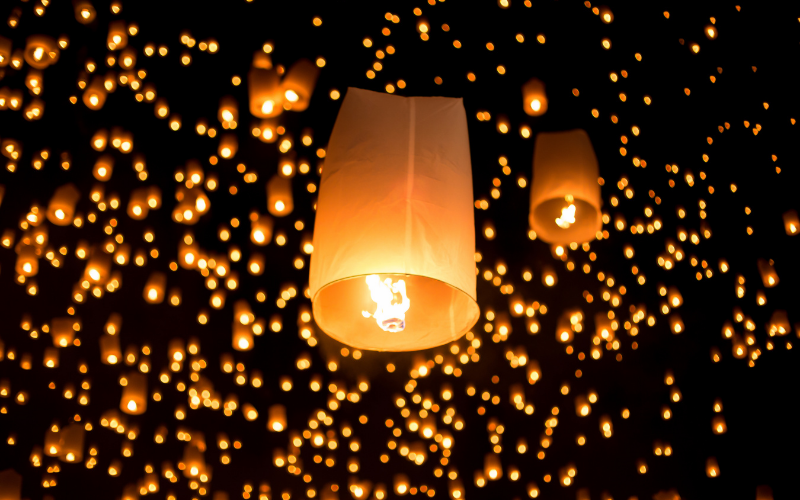
Releasing lanterns to pray for peace and good fortune
2. When and Where does the Yi Peng Lantern Festival in Chiang Mai take place?
The Yi Peng Lantern Festival 2026 was held from November 24th to 15th, organized by CAD Khom Loy.
As a major festival, the Yi Peng Festival lasts approximately three days. Within these three days, visitors can experience two large festivals simultaneously: the Yi Peng Lantern Festival and the Loy Krathong Festival. These two are separate festivals that overlap in time, meaning you can enjoy the Loy Krathong Festival (Water Festival) first and then participate in the upcoming Yi Peng Festival.
The Yi Peng Festival is celebrated throughout Thailand on varying scales depending on the region, with Chiang Mai being the most prominent. Visitors are encouraged to visit Chiang Mai if they want to experience the festival in its true, traditional form, as it is the festival’s birthplace.
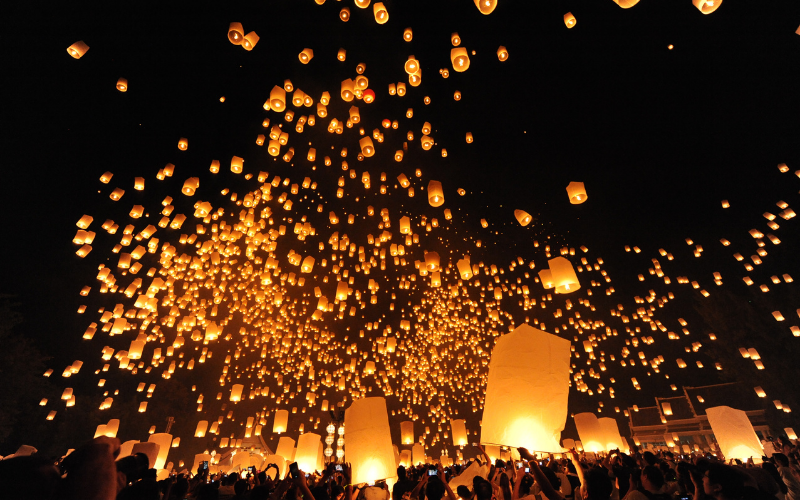
Chiang Mai – the birthplace of the Yi Peng Festival
3. Yi Peng Festival Timeline & Highlights
The festival will feature a wide range of activities, from public events and workshops to paid activities (including some special exhibitions/talks). Visitors can explore some of the main experiences at the festival to discover the culture:
Yi Peng Traditional Parade
Unlike the Songkran festival, which features a parade and the goddess Songkran, the Yi Peng festival focuses on honoring various deities and Buddha. Therefore, during the parade, people wear traditional Lanna costumes and march through the streets accompanied by music and dance. To best admire the traditional costumes and folk dances, visitors need to know the parade schedule, which is usually in the afternoon of the 3rd day of Festival.
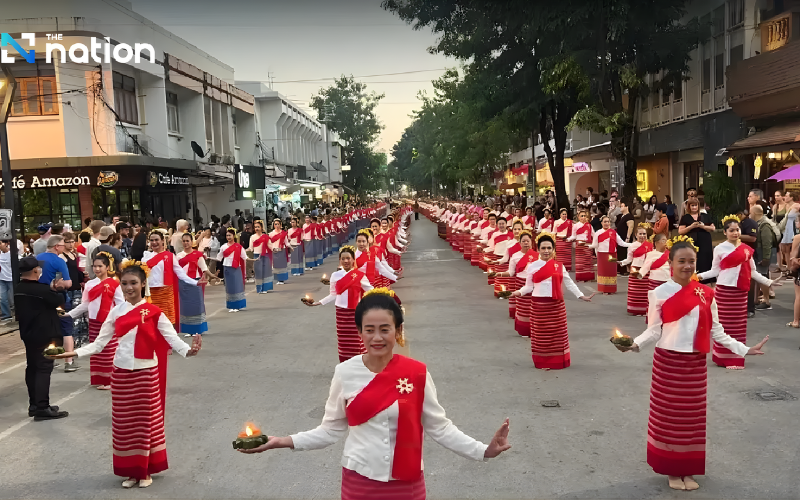
Traditional Lanna parade honoring Buddha and deities ( credit_ The Nation)
Lantern decoration in the ancient city
What makes the Yi Peng Festival unique is that every visitor has the opportunity to perform the ritual of “warding off bad luck” by releasing lanterns into the sky. There are two types of lanterns in this festival:
Yi Peng lanterns: These are made from paper (some places use rice paper to protect the environment). The lanterns are quite large, with a simple structure consisting of the lantern itself and a wick to light the fire, allowing the lantern to fly high. Tourists should note that Yi Peng lanterns are only released in suburban areas and open spaces. When releasing them, visitors should be mindful of crowds, especially in festival areas, and wait for the signal (usually from monks) before releasing the lanterns.
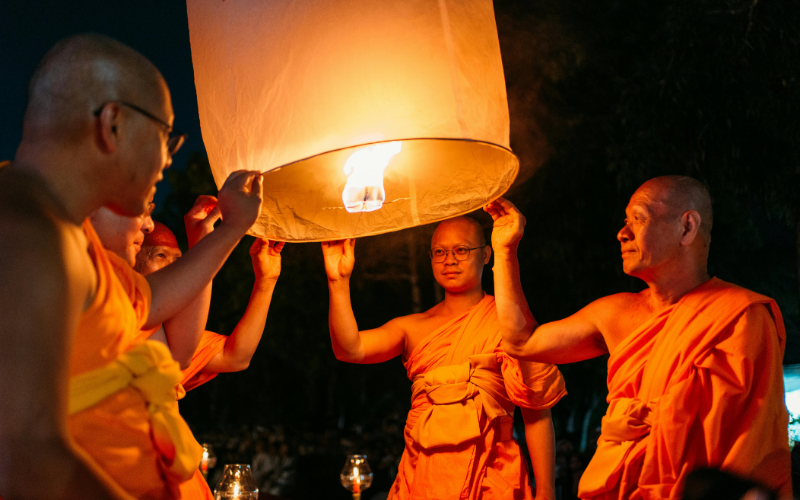
Yi Peng sky lanterns released under monks’ blessings
Loy Krathong lanterns: These lanterns are made from banana leaves and various flowers, with a candle in the center, then float down the river. Some locations offer workshops where visitors can personalize their own lanterns to their liking.Loy Krathong lanterns float on the water, people usually go to the Nawarat Bridge to do this ritual. Fireworks are often set off at the bridge.
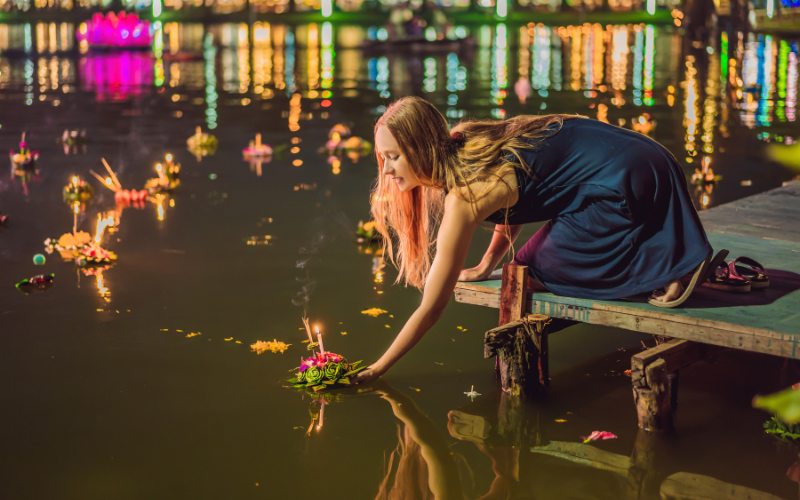
Loy Krathong lanterns floating on the river at night
During this special festival, visitors should be aware that both types of lanterns are sold by vendors; pay attention to the price before buying to avoid being scammed or overpaying.
Cultural performances, traditional Lanna dance
Several locations will host performances such as: traditional Lanna dance, Muay Thai demonstrations, traditional musical instrument performances, beauty pageants, etc. In particular, the traditional Lanna dance is unique with many variations, including: Fawn Leb (Nail Dance), Fawn Tian (Candle Dance), Fawn Ngiew (Scarf/Warrior Dance), Fawn Marn Gumm Ber (Butterfly Dance), and Fawn Marn MongKol (Happy Dance). Many tourists genuinely felt this was a wonderful opportunity to understand the culture, surprised by the friendly and cheerful atmosphere of the local people.
Visitors can check out The Three King Monument or Thae Pha Gate to see these performances. These locations are easily accessible by tuk-tuk or taxi as they are in the city center of Chiang Mai.
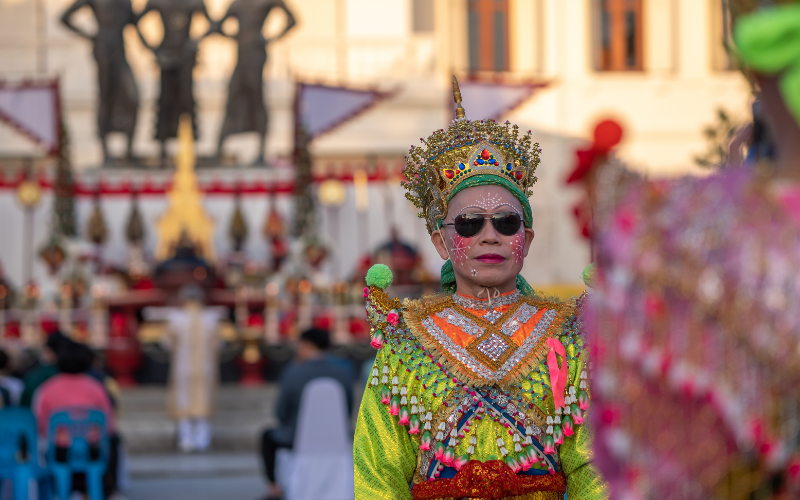
Traditional Lanna dance performances in Chiang Mai
Prayer ceremony
Originally a festival to pray for peace and ward off bad luck, besides the lantern-releasing ceremony, visitors can also visit temples to pray for good fortune.. On special occasions like this festival, some temples also hold prayer ceremonies. Visitors can visit Lanna Dhutanka Temple – a temple that has hosted the Yi Peng lantern-releasing ceremony many times – or Wat Buppharam Temple (near Nawarat Bridge). These ancient temples offer a tranquil escape from the hustle and bustle of the festival, providing a place to learn about Thai religious culture, spend time in quiet contemplation, and pray for good luck for yourself, your family, and a pleasant trip.
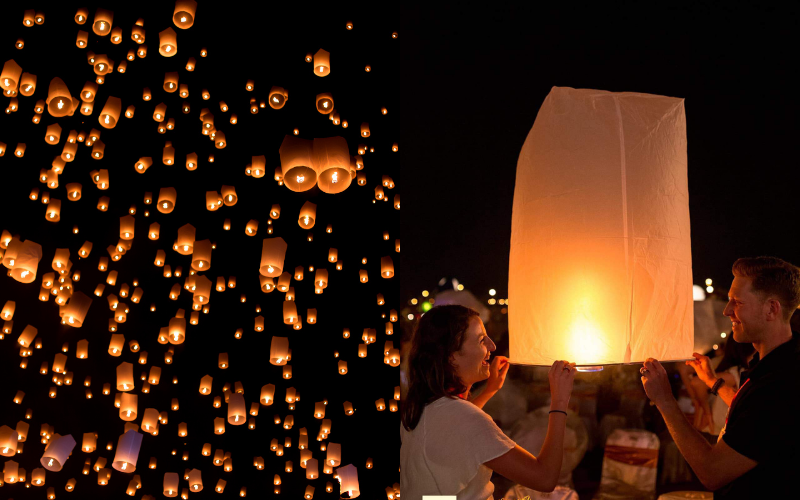
Quiet and less crowded moments during Yi Peng Festival
Local Village Festival – Doi Saket Village Festival
This location is 10km apart from Chiang Mai and suits the best for travelers who love and want to interact with the locals. However, the Yi Peng festival here is quite simple in scale; you can participate in traditional Lanna crafts, folk dances, and homemade culinary delights.
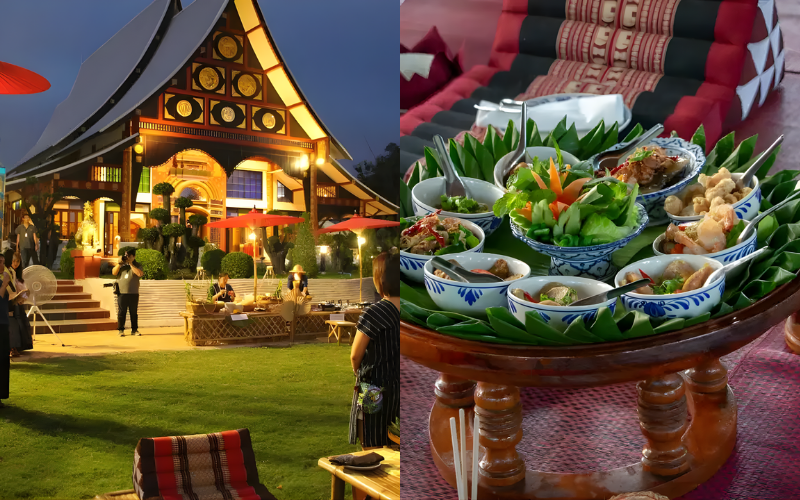
Local village life during Yi Peng in Doi Saket
4. How to Buy Tickets & Register for the Yi Peng Lantern Festival
Many organizations hold Yi Peng festivals of varying sizes. However, for a complete experience and to capture beautiful photos, many tourists are still encouraged to participate in the Yi Peng festival organized by CAD Khom Loy.
The CAD YiPeng event is held on a hill about 30km from the center of Chiang Mai city:
There are six ticket classes, with prices ranging from 4,900 to 15,900 Thai baht (approximately $156 to $506 USD). All ticket classes include a shuttle service from a designated pick-up point and a dinner buffet (excluding alcoholic beverages).
Normally, many tourists will choose the Standard ticket class. What is Included in a Standard Ticket of Yi Peng Festival:
– Ceremony entrance
– Lanna Thai Buffet (non-alcoholic drinks)
– 2 lanterns per person
– 1 krathong per person
– Access to all shows & activity zones
– Shuttle pickup and drop off at meeting
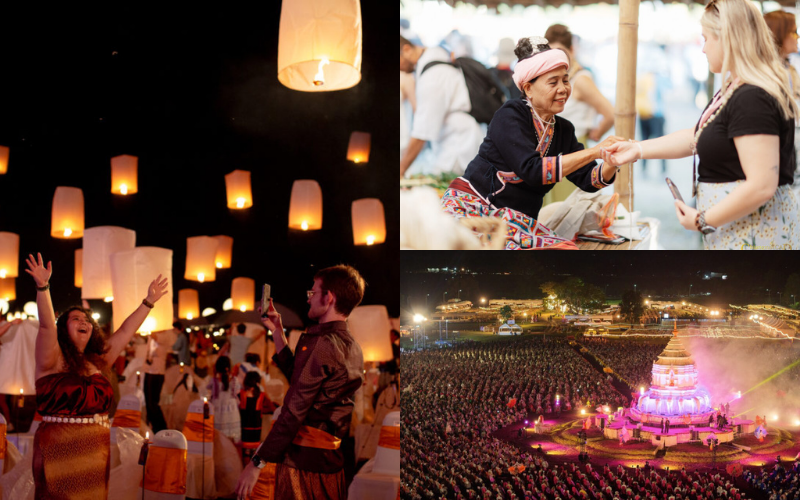
Yi Peng Festival organized by CAD Khom Loy
Visitors can refer to the website link of the organizer, CAD Khom Loy: https://yipengchiangmailanternfestival.com/
In particular, although the festival takes place in November, visitors should book tickets as early as possible, at least 6 months in advance, as tickets on the website sell out very quickly. Visitors should be cautious when purchasing tickets from individuals or agencies, and should carefully check the festival information on the tickets they sell, the seller’s reputation, etc.
Some feedbacks and informations about the Yi Peng festival by CAD Khom Loy:
– The pick-up point may vary depending on the ticket class and organizer requirements, but visitors should arrive early to catch the earliest available shuttle bus. Heavy traffic may cause congestion, and travel time to the venue is approximately one hour.
– Many tourists believe that eating at food courts should be limited, as many have experienced stomach aches.
– Visitors should use the restrooms beforehand or prepare personal backup options, as the festival attracts large crowds and restrooms can sometimes be overcrowded and smelly.
– Children under 8 years old accompanied by an adult are admitted free of charge; however, the festival is very crowded and takes place outdoors, so visitors should consider whether or not to bring children along.
5. How to get to Chiang Mai
If you are an international traveler, the most convenient option is to fly to Bangkok, the capital of Thailand. Suvarnabhumi Airport in Bangkok is a large airport with many direct flights from various countries, making it easy for travelers to find flights to Thailand. Furthermore, for Chiang Mai, the most convenient departure point is Bangkok.

Flying is the fastest way to reach Chiang Mai
There are several ways to travel from Bangkok to Chiang Mai:
Sleeper bus from Bangkok to Chiang Mai: 9 hours
The advantage of sleeper buses is their affordability. Travellers are encouraged to consider this type of bus instead of regular seated buses because they are more frequent, and the sleeper seats make long journeys (9 hours) less tiring.
The buses also have restrooms and light refreshments (pastries, drinks) are included in the ticket price.
Train from Bangkok to Chiang Mai: 9 hours
For trains, since the travel time is also long, around 10 hours, tourists should consider using sleeper trains.
When checking train ticket websites, search for the arrival station Krung Thep Aphiwat (if traveling from Bangkok) and the destination station Chiang Mai. From the list of trains that appears, select train number 9 with the words “special express cnr”. This is the best type of train, offering only sleeper berths, no regular seats. The train is reviewed as very comfortable with clean facilities, delicious food, and affordable prices, ranging from 190 Thai baht (approximately 6 USD).
Flight from Bangkok to Chiang Mai: 1 hour 20 minutes
Flying is the most suitable option for travelers who want to save travel time and avoid fatigue, as the flight time from Bangkok to Chiang Mai is approximately 1 hour and 20 minutes. Travelers can consider airlines such as Airasia, Bangkok Airways, etc.
Travelers should note that they should book their flight tickets early and prepare all necessary documents when checking in.
Additionally, depending on your destination from Vietnam, Cambodia, or other cities/countries, travelers can contact Asia Viva Travel for advice on the most suitable flight itinerary.
6. Getting to the festival area in Chiang Mai
In Chiang Mai, many tourists worry about being scammed when using transportation services. Tips to travel and choosing transportation in Chiang Mai:
Tuk-tuk
Tuk-tuks are Thailand’s all-time most popular vehicle, especially among tourists.. The advantage of this type of vehicle is that it’s fast, easily found on the streets, and most drivers are locals who know the routes very well. Tuk-tuks are also small, allowing them to take shortcuts to avoid peak hours.
Tourists should be careful when bargaining; you can bargain depending on the distance, and try to reduce the price by 20-30% compared to the driver’s initial offer.
Taxi or Grab
Tourists can also take taxis, but it’s best to use Grab Bike/Grab Car as you can see the total amount upfront, avoid scams, and easily determine the travel time.
Private Car
Many tourists prefer renting motorbikes or cas for more independent travel. Tourists should note that an international driving license is required for safety and based on laws.
There are many ways to get around Chiang Mai, but to reach festival locations (usually on the outskirts of the city), visitors should consider hiring a local driver to go in a private car. Always use a phone with an internet connection for convenient booking and to use translation apps to communicate with locals. Visitors should always book transportation and other services early because roads can be very congested during festivals.

Tuk-tuks and private cars during festival season
For private car and tour guides, this will be included in Asia Viva Travel’s itinerary in Thailand.
7. Suggested Chiang Mai Travel Itineraries Combining the Yi Peng Festival

Combining Yi Peng with Chiang Mai’s natural wonders
It’s wonderful that many tourists choose to combine exploring Chiang Mai with attending the Yi Peng festival because Chiang Mai is a great destination for nature lovers.
Depending on your travel itinerary, you can explore unique places in Chiang Mai in about 3-5 days:
– Pongyang jungle coaster: zipline, bungee,..
– Trekking Doi Inthanon
– Doi Suthep pagoda
– Elephants Home: bathing and preparing food for elephants
Life in Chiang Mai is very peaceful, and visitors can also spend time visiting local markets, experiencing the cuisine, or exploring local temples to learn about the culture. From Chiang Mai, visitors can also visit Chiang Rai,…
Additionally, for travelers departing from Bangkok, the following itinerary as a Classic Thailand trip is recommended. This trip has been designed so that travelers can explore Thailand’s culture and experiences in a simple itinerary
Day 1: Bangkok arrival
Day 2: Bangkok visit
Day 3: Bangkok – Ayutthaya – Bangkok
Day 4: Bangkok – Flight to Chiang Rai
Day 5: Chiang Rai visit
Day 6: Chiang Rai – Golden Triangle – Chiang Saen
Day 7: Chiang Saen visit – Chiang Mai
Day 8: Chiang Mai visit
Day 9: Chiang Mai – Elephant Nature Park – Flight to Bangkok
Day 10: Bangkok departure
8. About Yi Peng festival
QnAs 1: Basic Information about Yi Peng
Are Yi Peng and Loy Krathong the same?
No, these are two separate festivals. Although both aim to pray for good fortune and ward off bad luck, Yi Peng is a festival of releasing sky lanterns, while Loy Krathong is a festival of releasing floating lanterns on the river. Since both festivals take place at the same time, tourists visiting Chiang Mai to participate in Yi Peng can also participate in Loy Krathong.
How many days does the Yi Peng festival last?
The Yi Peng Festival lasts approximately 3 days according to the local schedule. For tourists participating in the Yi Peng Festival organized by CAD Khom Loy, they can choose one of two days to attend: November 24-25, 2026.
Is Yi Peng held in Bangkok or only in Chiang Mai?
Because Yi Peng is a religious festival, it is celebrated in various locations on different scales, with some rituals being substituted. Chiang Mai remains the most vibrant and largest venue, as it is the origin of the festival.
QnAs 2: Transportation & Planning Intent
Should I stay near the festival area?
Visitors can choose according to their needs. If you choose to celebrate the festival in the city center, you will have more options for accommodation, transportation, and services, but it will be quite far to reach the area where lanterns are released.
For visitors attending the festival organized by CAD Khom Loy, it’s worth considering the distance (about 30km), so you can use nearby accommodation if you return late (due to potential traffic congestion).
QnAs 3: Experience & Practical Notes (Experiential Intent)
Is releasing Yi Peng sky lanterns dangerous?
No, the lantern release area will be a designated area to ensure your safety and the safety of those around you. However, since the lanterns need fire to fly, you should be careful when near fire, especially when holding the lantern – it’s very easy to catch fire.
When lighting the candle before releasing the lantern, be careful and keep the lantern upright. Because the lantern is quite large, it’s best to have two people hold it. Release it in a spacious area and pay attention to those around you because your lantern could touch other lanterns and catch fire.
Do I have to buy the tickets for Yi Peng Festival?
Depending on the needs of visitors, ticketed festivals are professionally organized with performances, food stalls, and large-scale lantern-releasing ceremonies, including participation in prayers with monks. This is an exciting opportunity to participate, and it’s especially appealing to visitors who want to take beautiful photos, as the festival grounds are often located on a hill in the city’s suburbs, offering more space and allowing more visitors to participate in releasing lanterns.
Festivals are also held in the city center, but due to restrictions on releasing lanterns in the city center, visitors may need to travel a bit further to participate. But yes, many people still choose to celebrate the festival without taking part in the ticketed one.
Can I buy my own lanterns to release?
Yes, you can buy lanterns at stalls near the lantern-releasing area or participate in workshops included in the festival activities. For visitors who have purchased tickets for the Yi Peng Festival in CAD Khom Loy, each ticket includes two lanterns. And don’t forget to write your wish on the lantern before releasing it!
Tips for best photo in YiPeng Festival
With such a large space, stand a little further back, wear bright-colored clothes to stand out more, and you can wait 5 minutes after the signal to release the lanterns; this way, the background will have more twinkling lights.
The Yi Peng Lantern Festival is considered one of the most attractive and spectacular festivals in Thailand. The festival is an opportunity for visitors to learn about the traditional culture preserved and maintained by the Thai people. Furthermore, it’s a chance for visitors to make wishes and prayers in a unique way: by releasing a lantern with their wishes into the sky. Welcome to Chiang Mai, Thailand to celebrate the Yi Peng Lantern Festival 2026!
Book your Thailand tour with Asia Viva Travel!


